PDF READ FREE The Lives of the Constitution: Ten Exceptional Minds that Shaped America�s Supreme Law Online eBook
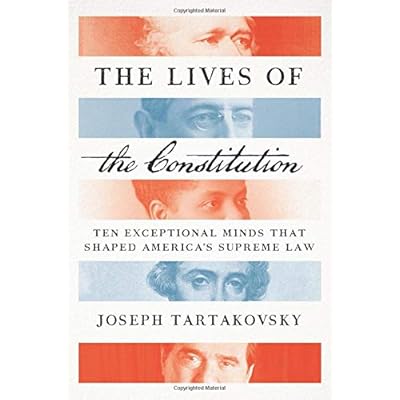
Description for The Lives of the Constitution: Ten Exceptional Minds that Shaped America�s Supreme Law
Review �Part history, part biography, and part legal analysis, The Lives of the Constitution is a unique account of how the American Constitution over two centuries has both changed and yet remained the same. Tartakovsky combines his pragmatic expertise as Nevada's Deputy Solicitor General with insightful legal scholarship to show how traditional categories like �strict constructionist� or �progressive� do not�always�reflect the unexpected ways in which the Constitution has both enriched America in times of evolutionary change and yet saved America from radical transformation. A wholly original approach and analysis.� ? Victor Davis Hanson, Senior Fellow, Classics and Military History, the Hoover Institution, Stanford University, author of The Second World Wars �The Lives of the Constitution is as supple, smart, and opinionated as the ten men and women it depicts. Joseph Tartakovsky will surprise and instruct you on every page.� ? Richard Brookhiser, author of Alexander Hamilton, American �Joseph Tartakovsky brings that rarest of combinations: a writer who has studied the law in a demanding way, but also seen the law through the prism of moral and political philosophy--and then writes in the most graceful and illuminating manner.� ? Hadley Arkes, Senior Fellow at The Claremont Institute �Avoiding legal jargon and sketching vivid, memorable portraits of his subjects, the author offers a scholarly yet accessible book to general audiences. Verdict: A thoughtful, clever work on how different generations have thought about the Constitution. Well worth the time of American history and law students.� ? Michael Eshleman, Library Journal, starred review �[A] fascinating and lively way to recast the nation�s founding document.... [Tartakovsky] introduces a novel twist: The proper way to understand the Constitution is not simply to engage in historical exegesis or textual commentary, but to view it primarily as �a story of human beings�.� [He] is well served by his ability to communicate important points with an enviable brevity.� [I]t is a credit to Tartakovsky that he has reminded us of the vitality of our founding document in such a novel and unassuming way.� ? Jay Cost, National Review magazine �The striking thing about Tartakovsky's book is its unflagging combination of deep Constitutional and historical wisdom, beautiful and elegant writing, occasional and appropriate lyricism, and the quality of easily leading the reader forward with the greatest enjoyment. His extraordinary talent is such that as a story teller he could take the baton from David McCullough or, as a jurist (if a future president has enough wisdom to appoint him to the Supreme Court), Antonin Scalia. Yes, he is that good.� ? Mark Helprin, author of Winter's Tale, A Soldier of the Great War, and most recently Paris in the Present Tense Read more About the Author Joseph Tartakovsky is the James Wilson Fellow in Constitutional Law at the Claremont Institute for the Study of Statesmanship and Political Philosophy. His writing has appeared in the New York Times, Wall Street Journal, and Los Angeles Times, among other publications. As a lawyer, he has served as the Deputy Solicitor General of Nevada, a white-collar criminal litigator at an international law firm, and as a law clerk to a federal appellate judge. Read more Excerpt. � Reprinted by permission. All rights reserved. Chapter 1 Alexander Hamilton A War Ends and a Constitution Begins In the winter of late 1783 the bells pealing in Albany and Manhattan to celebrate the peace between the renegade colonies and his semi-sane majesty must have sounded, to loyalists, like death knells. A half-million souls across the colonies stayed true to George the Third; in New York alone, in 1776, loyalists had amounted to nearly half the state�s population. Alexander Hamilton, a Wall Street lawyer in his late 20s, understood why New York�s patriots, a fever for vengeance crackling in their blood, were now robbing, exiling, hamstringing (disabling by cutting that muscle), and murdering those they called traitorous �parricides.� The war had been fratricidal and eight years long, our longest until Vietnam, and no place was occupied longer than New York City. New Yorkers saw their homes burned, streets denuded of trees, churches used as stables; they saw 11,500 friends and family die on reeking East River prison ships, bones still washing ashore a decade later. It was a time of crisis, and precisely what Hamilton needed to uncoil the powers that would make him loved and feared. He was meddlesome, imaginative, audacious, overbearing, pragmatic, indiscreet, charming, and tireless. He spoke with a confidence so unwavering that one might have supposed he had returned from the future. Alexander Hamilton was shaken by the cruelties of his countrymen, who had discovered that duly enacted laws could ruin a hated minority faster than street reprisals. A statute from 1784 authorized the sale of seized Tory estates. Philipsburg Manor in Westchester, alone, was parceled out to 287 new landowners, averaging 174 acres apiece. Another law �forever� disenfranchised most Tories for �holding principles inimical to the Constitution,� though it mercifully exempted minors and the insane. When the 1783 Trespass Act encouraged patriots to sue Tories who had moved into the houses or used the businesses of patriots, an alarmed Hamilton began taking loyalist cases. Those breathing revenge, he felt, really only coveted a neighbor�s house or the chance to eliminate a creditor or business rival, and for these unworthy motives New York was violating the treaty Americans had signed with Great Britain and risking the peace that the nation as a whole had achieved. But most of all Hamilton feared what New Yorkers� persecutions said about their character. �[W]e have taken our station among nations,� he wrote, in early 1784, under the pseudonym Phocion, but now behaved like the dishonorable Greek tribe who pledged to return an enemy�s prisoners only to execute them and return the corpses. He closed with a warning: �The world has its eye upon America,� but if our misbehavior showed that the �bulk of mankind are not fit to govern themselves,� then with the �greatest advantages for promoting it, that ever a people had, we shall have betrayed the cause of human nature.� ��� The island of Nevis, a mountainous 36-square-mile speck in the Caribbean where Alexander Hamilton was born in 1755, looks like a jungle paradise. But for inhabitants, the azure waters lapping white sands, the drowsy palms and laughing parrots, probably seemed meager compensation for the earthquakes, hurricanes, pirates, isolation, malaria, and crime. �While other founding fathers were reared in tidy New England villages or cosseted on baronial Virginia estates,� writes Ron Chernow in his 2004 biography of Hamilton, Alexander �grew up in a tropical hellhole of dissipated whites and fractious slaves.� Hamilton regularly witnessed auctions of sugar-cane slaves, with buyers who arrived with branding irons to sear living skin. He was entrusted at age 14 as a clerk for a local merchant. A letter shows Alexander reporting to his boss in stream-of-consciousness style: �I sold all your lumber off immediately at �16 luckily enough, the price of that article being now reduced to �12, as great quantities have been lately imported. Indeed, there must be a vast consumption of this crop?which makes it probable that the price will again rise?unless the crops at windward should fall short?as is said to be the case?whereby we shall stand fair to be overstocked.� Alexander managed shipments of mules and codfish, calculated currency exchanges, advised captains to arm against buccaneers. It was an unmatchable apprenticeship in the centrality of trade, credit, and commerce to the fate of nation. Alexander Hamilton�s life had strikingly modern touches. He was the son of a single mother who worked as a shopkeeper. When she died, Alexander, and his older brother James, both teenagers, were left alone and disinherited. The remainder of his Nevis family life was one sad fact after another. The town judge had to buy Alexander shoes for his mother�s funeral. Years later, at his wedding to Eliza Schuyler, the daughter of a powerful New York patroon, not a single family member appeared on his side. Hamilton had everything against him, except the prodigious intellect that led a few local merchants to pay his way to King�s College in New York City. He arrived on the continent in 1773, said a biographer, slight and slim, with a �bright, ruddy complexion; light-colored hair; a mouth infinite in expression, its sweet smile being most observable and most spoken of; eyes lustrous with meaning and reflection, or glancing with quick canny pleasantry, and the whole countenance decidedly Scottish in form and expression.� In 1776 he dropped out of college?another admirable modern touch?to take command of 68 men as a 21-year-old artillery captain, braving British fire (recklessly, some thought) and supplying his troops at his own expense. He soon became a staff officer to George Washington, the beginning of a historic two-decade alliance. The sonless Washington called the fatherless Hamilton �my boy,� and fellow officers remembered �Call Colonel Hamilton� as Washington�s instinctive utterance when important news arrived. Hamilton could write more forcefully than anyone, spoke the French of our allies, and handled politicians like a diplomat. Hamilton was also the sort able to find time between negotiating prisoner exchanges and dodging cannon-fire to begin a systematic study of economics. He filled an artillery notebook with items one might expect to interest a future Treasury Secretary: how Hungarian corn is six times cheaper than English corn, for instance, or that goats might be profitably raised for skin and hair in the South. His self-education would make him the most learned founder on finance, rivaled only by his friend Gouverneur Morris, a hilarious, peg-legged cynic who was so intellectually akin to Hamilton that Hamilton invited Morris, before Madison, to co-write the Federalist. Hamilton�s political views arose from his wartime service. He thought that America�s headless, incompetent Congress got Americans killed. Congress was trying to fight a war by legislative committee, such as by setting prices and ordering troop movements, all directed by constantly rotating, often corrupt personnel. General Washington�s supplies allowed his untrained men to fire only two practice rounds before engaging skilled Redcoats. Charles Willson Peale, later famed as a painter, recalled how after the Battle of Princeton, to save his exhausted men from another night of hunger, Peale begged door to door until he had enough beef and potatoes for their meal. �[N]othing appears more evident to me,� wrote Hamilton, midway through the war, �than that we run much greater risk of having a weak and disunited federal government, than one which will be able to usurp upon the rights of the people.� The states had been loosely allied since 1781 under the Articles of Confederation, which created not a government but a treaty between independent sovereigns. It functioned like the United Nations: a frequently chaotic gathering of �delegates� representing effectively separate, self-interested nations, empowered only to issue non-binding resolutions, and wholly inept at maintaining peace. James McHenry, an Irish-born surgeon who served at Valley Forge with Hamilton, wrote his old comrade that bold measures were difficult with a �people who have thirteen heads each of which pay superstitious adoration to inferior divinities.� It is no wonder that many of the most committed future Federalists?the name for the nationalist party that would come to govern during the first decade and a half under the U.S. Constitution?were ex-officers. John Marshall, later the fourth Chief Justice of the Supreme Court, confessed that his captaincy during the war instilled in him his habit of �considering America�?not Virginia?�as my country.� Hamilton, as the war was winding down, laid out the choice before the country in a six-part essay series he signed �Continentalist.� We could become a �noble and magnificent� federal republic, he wrote, �closely linked in the pursuit of a common interest, tranquil and prosperous at home, respectable abroad,� or we could stumble on in our �diminutive and contemptible� course, as a �number of petty states, with the appearance only of union, jarring, jealous and perverse, without any determined direction, fluctuating and unhappy at home, weak and insignificant by their dissensions, in the eyes of other nations.� His choice was obvious, but he was unsure about whether the crumbling American alliance would even hold. After the war he urged George Clinton, New York�s formidable governor, who had privateered against France at 16 and invaded Canada by 20, to hand out land to officers to entice their settlement in New York?just in case the state had to fend for itself. Some veterans, said Gouverneur Morris, �anticipated with horror the moment when they might be called on to unsheathe their swords against each other.� In the late 1780s Greenwich Village was still a village and Long Islanders were farmers, but New York City was already, in ethnic and religious terms, the most diverse city in North America. It was full of merchants and gazettes. Yet streets also thronged with crippled men, widows, and bankrupts; hundreds of soldiers returned from war only to be jailed for debt. Rampant were suicides, counterfeiting, thefts of whole flocks of sheep. No state, Hamilton felt, better illustrated the need for a federal constitution to unite the states and so bring order and prosperity. But having shaken one foreign ruler, no state was less eager to accept another. New York State, in fact, became the great drag on the continental project. When Congress relocated to New York City in 1785, the state�s refusal to find office space for it forced the legislature to lease a tavern. Governor Clinton declared that the act of �confederating� with other states under a single government was unnecessary: the future Empire State had fertile lands, commanding waterways, and choice ports that brought the state a fortune in tariffs and taxes. New York City was probably the entrep�t to half the goods consumed in Connecticut and New Jersey. Connecticut, in the early 1780s, had bravely declared that it would allow free trade between the states in the hope that New York would follow suit, but by 1787 it found itself annually paying �100,000 of coerced �tribute� into New York�s pockets. An infuriated Nutmeg State sought to block all exports to New York and to deny its ships landing. New Jersey, for its part, enacted retaliatory tariffs against New York. New Yorkers, particularly the farmers at the heart of the anti-union movement, loved how this income permitted the state to keep land taxation light. The U.S. Constitution was drafted in Philadelphia in summer 1787 and sent out to the states for ratification, to take effect if nine ratified. Eight states had already ratified by the time New York even began its convention to consider ratification in Poughkeepsie. George Clinton�s anti-Constitution partisans were glad to let other states go first. Hamilton, the acknowledged leader of the pro-Constitution forces, also favored delay: with only a third of the convention delegates believed to be friendly to the proposed Constitution, he felt that his side�s only hope was that ratification by other states would shake Clinton�s moderates. The state was split between the southernmost counties, led by a commercial New York City, and upstate farming counties, led by Albany, whose leaders prayed, as Clinton�s nephew put it, that from �tax gatherers, standing armies, navies, placemen, sinecures, federal cities, Senators, Presidents and a long train of et ceteras Good Lord deliver us.� Hamilton calculated rightly. Midway through the Poughkeepsie convention, New Hampshire and Virginia signed on. The question for New York then shifted from approval of the Constitution to whether to isolate itself, militarily and commercially, by staying out of the new union. There was genuine fear that if the state kept out, Staten Island would peel off and join New Jersey, and New York City and Long Island would link up with Connecticut. So the Constitution came to New York, by vote of 30-27. Hamilton�s decisive influence in the close-run affair led some exuberant Manhattanites to propose that New York City be renamed �Hamiltonia.� ��� Presidential candidates today, even after two unbroken centuries of elections, find it hard to avoid doomsday talk about America�s survival. When Americans in the 1790s spoke this way, it had the merit of being true. The physical downfall of the fragile new government under the Constitution?the �experiment,� as that generation liked to call it?was altogether possible in an age when an unluckily placed boulder in a river, as George Washington found, could still stop the movement of an American president. In 1792 Hamilton found it �curious� that �[o]ne side appears to believe that there is a serious plot to overturn the state Governments and substitute monarchy to the present republican system,� while the other �firmly believes that there is a serious plot to overturn the General Government & elevate the separate power of the states upon its ruins.� He was in a position to know: the opposition force that inaugurated our two-party system arose as an anti-Hamilton party. Hamilton was named the first Secretary of the Treasury, at age 34, and served for five and a half years. In December 1790, after the government had been in effect for a matter of months, Virginia�s legislature declared that Hamilton�s first major economic initiative?to have the federal government absorb state war debts?was not just unconstitutional but �fatal to the existence of American liberty.� The Father of his Country was still largely untouchable, so Hamilton took the heat, much in the English tradition of attacking the minister, not the king. Jefferson, as Secretary of State, started in privately with President Washington on how his fellow cabinet member had secret plans for a homegrown monarchy, which he, Jefferson, thought self-evident especially in the way Hamilton �shuffled� around millions of dollars. In 1792 an exasperated Washington urged a truce between Hamilton and Jefferson, whose intensifying warfare?�daily pitted in the cabinet like two cocks,� Jefferson recalled?was �tearing our vitals,� in Washington�s words, at a time when the nation was �encompassed on all sides� by enemies. The U.S. was then a long thin strip of a country, like Israel or Chile, wedged up against a sea that it did not control, on a coast and continent roamed by three European empires. Above all were the behemoths England and France, whose clash kept the world at war for the rest of Hamilton�s life and left Europe strewn with the carcasses of overthrown regimes. America felt the crushing strain of a small besieged African nation trying to survive the Cold War. At first Hamilton was amused, if uneasy, when the revolutionary French Republic made him honorary citizen �Jean Hamilton� in 1792. A few months later Parisian radicals beheaded Louis XVI, our ally from a decade earlier. By then hysteria and delirium had broken lose stateside. Better to have the United States �erased from existence than infected with French principles,� cried the Federalist Oliver Wolcott, Jr., who would succeed Hamilton as Treasury Secretary. Jefferson, by contrast, saw the �liberty of the whole earth� turning on the success of the �Jacobin� cause, adding, with customary sangfroid, that �rather than it should have failed, I would have seen half the earth desolated.� John Adams recalled that in spring 1793, 10,000 people took to Philadelphia�s streets, day after day, threatening to �drag Washington out of his house, and effect a revolution in the government, or compel it to declare war in favor of the French Revolution.� Hamilton dreaded that the U.S. would stumble into a war with Europe during his entire public career?first France in 1793, then England in 1794, then France again in 1797. These were wars, he felt, that we were perilously unequipped to fight. France installed or sponsored puppet �sister republics� in the Netherlands, Germany, Switzerland, and Italy. Hamilton, as time wore on, came to believe that revolution-exporting France had American sympathizers prepared to �cut off the leading Federalists and seize the government.� In 1797, after the stabilizing Washington was succeeded by the less balanced Adams, and the French-American Quasi-War began, the British foreign secretary wrote that the �whole system of American government� seemed to be �tottering to its foundations.� Then the 1800 election returned a tie between Jefferson and Aaron Burr so fraught and volatile?Jefferson eventually won on the 36th House ballot, by two votes?that Pennsylvania and Virginia, emotions at a boil, began arming for an anticipated struggle. That election was an extraordinary event in history: the first transfer of national power between rivals after a popular, periodic election in the recorded history of our violent species. Today we know parties cede ground back and forth like football teams. The founders did not, which is why they so often could not distinguish disagreement from disloyalty. It is no exaggeration to say that for stretches in the 1790s, a good portion of Americans thought revolutionary France more true to the cause of 1776 than Alexander Hamilton and even George Washington. The party wars of that decade were so unbearably intense, Jefferson recalled, that lifelong friends crossed streets to avoid meeting. Hamilton was a man constantly in motion, like a shark that must keep swimming to breathe. A friend remembered a publisher in Hamilton�s study at home, waiting to take Federalist essays �as they came fresh� from Hamilton�s quill, composed between breaks in his law practice. Hamilton eventually wrote under so many pen names that he may have been, says biographer Ron Chernow, the �foremost political pamphleteer in American history.� At one point Hamilton began a 38-part series under the name �Camillus,� to debate the Jay Treaty in 1795 between the United States and Great Britain, then two days later began a second series, as �Philo Camillus,� defending �Camillus,� a cascade of words that led Jefferson to exclaim to Madison that Hamilton was an army �within himself.� That was when he wasn�t writing for others. An editor recalled that when he needed material, he would visit Hamilton late at night. �As soon as I see him,� the editor said, �he begins in a deliberate manner to dictate, and I to note down in short-hand. When he stops my article is completed.� Hamilton�s habit of constantly mumbling to himself suggests an almost unmanageable mental ferment. Hamilton�s father-in-law once wrote Hamilton�s wife to report, in amusement, that a shopkeeper refused to accept a large bill from Hamilton, in the belief that he, the shopkeeper, would be faulted for taking a madman�s money. �I have seen him walk before my door for half an hour,� the shopkeeper said, �always talking to himself.� Hamilton was built for national executive work. He declined nominations for New York Governor (too parochial), U.S. Senator (too many colleagues), and Chief Justice of the U.S. Supreme Court (too boring). His writings vibrate with words like �energy,� �vigor,� �efficiency.� He wanted to give government �new life,� to have it conduct its business �with dispatch, method, and system,� to see the �well-proportioned exertion of the resources of the whole.� He saw limits, too. When he read the draft Sedition Act in 1798?which allowed the jailing of administration critics?he rebuked its authors. �Energy is a very different thing from violence,� he said. �Let us not establish a tyranny.� He even seemed to gainsay the views of George Washington, who had written Adams�s Secretary of War, from his retirement at Mount Vernon, to warn against bringing �professed Democrat[s]� into the army. Hamilton thought that putting party above merit forfeited an opportunity to create friends to the government. The presidency, the stage on which Hamilton would strut, was a new office for Americans. What was the vague �executive power� created by Article II of the Constitution? In 1789 Hamilton�s friend James McHenry told Washington, �You are now a king, under a different name,� and sent wishes that Washington might �reign long and happy over us.� John Adams bridled that Washington would be called, simply, �President,� and not his �Most Benign Highness,� since there were �presidents of fire companies and of a cricket club.� So many Americans reached for familiar kingly precedent that Washington felt obligated, in his draft First Inaugural address, to remind his people that he was childless. True, he did wear a ceremonial sword and ride in a cream-colored coach attended by liveried servants, but the republican reality was captured by an Englishman who visited him in 1795 in Philadelphia?and found the old warrior domiciled in a simple brick house, near Fourth Street, next to a hairdresser�s shop. Hamilton was interested not in superficial titles but action. In ghostwriting Washington�s 1796 Farewell Address, he knew he spoke Washington�s mind when he wrote that the �real danger in our system is that the general government, organized as at present, will prove too weak rather than too powerful.� Both Washington and Hamilton knew from the war that no legislature could ever match the concentrated intelligence, speed, and discipline of an official who is always on duty?one reason that even today the President works in the same building that he lives in. Federalist preoccupations were soon tested when, in August 1794, 7,000 �whiskey rebels� marauded through western Pennsylvania, setting up mock guillotines and burning the homes of tax officials?the largest incident of armed resistance to federal authority until the Civil War. The rebels considered Hamilton�s Excise Act a new Stamp Act, but to Hamilton the Excise Act was the second-largest source of federal revenue. Hamilton two years earlier had tried to lower the rate in conciliation, but now rebuffed, energy kicked in. Hamilton wrote detailed advice to Washington on the number of troops needed and ordered army blankets, medicine chests, and muskets, even specifying the materials to be used for jackets. Hamilton had a martial-romantic streak and at night roamed the camp in which federal forces gathered against the rebels. When one soldier complained, Hamilton took the gun himself and paced until relieved. He believed public trust to be essential to durable government. When Pennsylvania militiamen riding to meet the rebels killed two citizens, he rebuked Pennsylvania�s governor: troops �cannot render a more important service to the cause of government & order,� he said, �than by a conduct scrupulously regardful of the rights of their fellow citizens and exemplary for decorum, regularity & moderation.� President Washington believed it of �infinite� importance to get right the precedents he was setting on the many questions the Constitution was silent on. He was acutely aware that his acts would obtain pseudo-constitutional status. Among the precedents settled by twelve years of Federalist rule, largely in Hamilton�s favor: Could the House of Representatives demand the President�s confidential papers on foreign affairs? On this Washington, as always, sought the advice of Hamilton (who, sorely in need of income, had returned to private law practice a year earlier). Washington thanked Hamilton for confirming that Washington was right to refuse the House�s request and indeed �to resist the principle.� Could legislators investigate executive officials?the first to receive such an honor, in fact, being Hamilton himself? Trumped-up accusations drafted by Jefferson and Madison challenged Hamilton over his management of loans in 1793. Hamilton was exonerated and would be, again, after another investigation in 1794. Hamilton himself, even on questions of presidential authority, got a practical education. In a Federalist essay, for instance, he doubted that Senators would actually use their advice-and-consent power to try to influence the president�s picks; in fact, senatorial �recommendations� to Washington started rolling in immediately. When the First Congress asked Hamilton to report to it on economic policy, Congress began the tradition of executive initiative in legislation. Hamilton in 1790 and 1791 produced three major �reports,� on debt and taxes, a national bank, and manufacturing. These foundations of the American school of economics established Hamilton�s influence in his time more than any other achievement. Congress�s skeptics?mostly among the anti-Hamilton party, now called the �Republicans�?were not charmed by what they received. �Some say the Secretary�s Reports are like Smith�s Treatise on the Wealth of Nations,� said one, accurately, adding, �We do not come here to go to school.� The Report on Public Credit was dense enough that most lawmakers probably forgave themselves for declining to read it. Hamilton went through specific duties for Hyson tea, green tea, souchong tea, and bohea tea, before informing Congress that he had mostly �omitted details to avoid fatiguing the attention of the House.� Hamilton also drafted laws, decided congressional committee memberships, and arrived early at sessions to lobby the Speaker. Another Congressman scolded him for �seem[ing] to take the whole Government upon his shoulders� and for speaking the �language of a Frederick of Prussia, or some other despotic prince.� ��� �The sacred rights of mankind are not to be rummaged for among old parchments or musty records,� wrote a young Hamilton, in an exquisite passage. �They are written, as with a sunbeam, in the whole volume of human nature, by the hand of the divinity itself, and can never be erased or obscured by mortal power.� But he knew that officeholders did not spend their days reaffirming sacred rights. Even the most worshipful parsing of Locke and Montesquieu yielded little about how to run a post office. Hamilton had pondered the �practical business of government� for over a decade before the Constitution took effect. He subscribed to the couplet of Alexander Pope, his favorite poet?and, more even than Shakespeare, the semi-official poet of the American founders?who wrote: For forms of government let fools contest; Whate�er is best administer�d is best. Hamilton observed at the Poughkeepsie ratifying convention that governments as exotic as Sparta�s ephori or the tribunes of Rome had succeeded. One might add that the great Qing, Ottoman, and Bismarckian empires also owed their conquering superiority to administrative effectiveness, not to liberalism. Hamilton worried that our Constitution, as framed, lacked �energy,� but he intended, through invigorating administration, to prove it worthy of the �affection of the people.� Leonard D. White, the historian of American administration, wrote that Hamilton was not only the �greatest administrative genius of his generation in America,� but �one of the great administrators of all time.� Under Hamilton the Treasury Department became the largest, richest, most efficient enterprise on the continent. Hamilton began with 39 employees, fewer than a large northern shipyard of the day. By 1801 it made up more than half the total civilian federal government, embodied in 1,615 field officials: army and navy accountants, loan commissioners, customs collectors, revenue surveyors, land-office receivers, district attorneys, deputy postmasters, marshals, Indian agents, coastal seamen, and lighthouse keepers. This was the machinery of a modern state, even if, in size, it was a fraction of Cleveland�s government today. The State Department, by contrast, after a decade, remained content with ten employees. Its paper operations were confined to a single desk, which kept letters from foreign governments in two pigeonholes on the right side, and foreign treaties in a pigeonhole on the left. Enemies saw Hamilton as creating an imperium in imperio that threatened liberty. Hamilton saw just the opposite: a robust Treasury Department was necessary to protect rights. He felt his opponents did not grasp that less government usually does not mean less oppression of property, but, to the contrary, l
Books are everywhere. Libraries big and small and bookstores are splattered all over college campuses and larger cities. They are all filled with one of the most important things of all time—books. Those who read books appreciate the multiple places to find books. Those who aren’t fans of books, don’t understand what could make readers want to obsess over books. There is a reason for their obsession, though. You hear it all the time: read every day.Reading is important because it develops our thoughts, gives us endless knowledge and lessons to read while keeping our minds active. Reading books to help us learn and understand and makes us smarter, not to mention the knowledge, vocabulary and thinking skills we develop.In the world today where information are abundant, reading books is one of the best ways to be informed. Though reading might seem like simple fun, it can be helping your body and mind without you even realising what is happening. What makes reading so important? It can be for these reasons and not just knowledge.For those who don’t enjoy it, you might change your mind after hearing about the benefits. Can something so easy and fun be so helpful in your life? Of course, it can! Reading can be a great benefit to you in many different ways—such as sharpening your mind, imagination, and writing skills. With so many advantages, it should be an everyday occurrence to read at least a little something.Books can hold and keep all kinds of information, stories, thoughts and feelings unlike anything else in this world. Can words, paragraphs, and fictional worlds be all that great for you and your health? It definitely can, and it is a timeless form of entertainment and information
Step-By Step To Download The Lives of the Constitution: Ten Exceptional Minds that Shaped America�s Supreme Law
- Click The Button "DOWNLOAD" Or "READ ONLINE"
- Sign UP registration to access & UNLIMITED BOOKS
- DOWNLOAD as many books as you like (personal use)
- CANCEL the membership at ANY TIME if not satisfied
- Join Over 80.000 & Happy Readers.
OR



No comments:
Post a Comment