[read ebook] Unelected Power: The Quest for Legitimacy in Central Banking and the Regulatory State (Ebook Online)
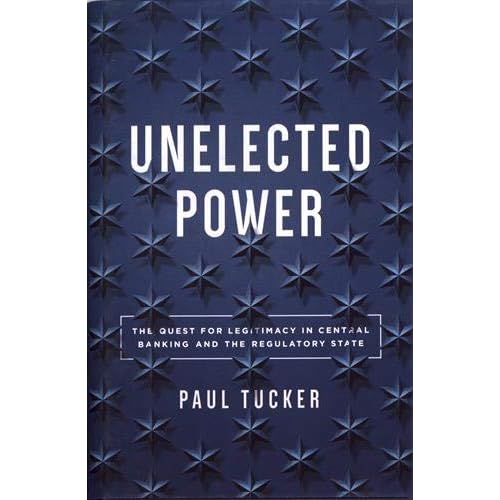
Description for Unelected Power: The Quest for Legitimacy in Central Banking and the Regulatory State
Review 'A book about central banking that begins with Britain�s vote to leave the European Union, America�s election of Donald Trump as president and Continental Europe�s rising populism is starting in the right place. That alone gives Paul Tucker�s Unelected Power: The Quest for Legitimacy in Central Banking and the Regulatory State a claim as one of the more perceptive books on his subject in recent years.'---Joseph C. Sternberg, Wall Street Journal'A comprehensive and thoughtful guide to the limits of . . . unelected power.'---Peter Thal Larsen, Reuters Breakingviews'[It] shows how central banks have become a huge part of what [Tucker] calls the administrative state.'---Daniel Ben-Ami, Spiked'Unelected Power . . . runs the gamut from philosophy, to politics, to economics and back again. This is much more than a policymaker�s set of memoirs, this is a manual for righting some wrongs.'---Mark Blyth, Rhodes Center Podcast'A terrific book.'---Anil Padmanabhan, liveMint'Tucker�s synthesis of economics, law, political science, and political philosophy is prodigious, and his experience on the front lines of fighting the global financial crisis is imposing. And yet, what is most distinctive about the book is its humility. Tucker�s worry that he and his ilk have become 'overmighty citizens' is palpable, and he takes seriously the idea that bureaucrats must ultimately be servants rather than masters. . . . His attitude comes from a kind of modern sense of noblesse oblige, heavy on the obligation. Let us hope Tucker can inspire others who wield unelected power to feel and act on this sense as much as he does.'---Philip A. Wallach, American Interest'One of Foreign Affairs' Picks for Best of Books 2018''Tucker is refreshingly upfront about central bankers� acquisition of power.'---Desmond King, Financial Times'One of Marketwatch's Nonfiction Best of 2018 Books''[As] Paul Tucker . . . discusses in [his] masterful recent book . . . the argument for democratic delegation is a subtle one.'---Dani Rodrik, Project Syndicate Read more Review 'Profoundly important. . . . [Tucker�s] practical experience with the tensions he addresses, combined with his distance from conventional academic disciplines, makes his writing both more accessible and more convincing than much of what is produced by administrative-law specialists and political scientists. . . . In the wake of the financial crisis of 2008, policymakers continue to reassess the ways in which government and the financial sector interact. Democratic institutions are facing a reappraisal in light of the widespread populism of the past few years. Tucker�s arguments ought to be carefully considered. Of the many books written by those involved in responding to the financial crisis, his may deserve the longest shelf life.'�-Lawrence Summers, Washington Post Read more Review 'Tucker�s synthesis of economics, law, political science, and political philosophy is prodigious, and his experience on the front lines of fighting the global financial crisis is imposing. And yet, what is most distinctive about the book is its humility. Tucker�s worry that he and his ilk have become 'overmighty citizens' is palpable, and he takes seriously the idea that bureaucrats must ultimately be servants rather than masters. . . . His attitude comes from a kind of modern sense of noblesse oblige, heavy on the obligation. Let us hope Tucker can inspire others who wield unelected power to feel and act on this sense as much as he does.'--Philip A. Wallach, American Interest Read more From the Back Cover 'Paul Tucker brings years of experience at the Bank of England and deep political-economic insights to the most contentious problem of governance today: the delegation of power to independent agencies of government. He shows that the Fed and other central banks have become powerful multipurpose institutions, escaping checks and balances, risking all independence. He then unpacks an entirely novel solution--his Principles for Delegation--which will set off a needed debate over reform for many years ahead.'--John B. Taylor, Stanford University'This book is a much-needed study of a much-neglected problem. Combining experience with theoretical expertise, Paul Tucker offers us an insightful and original account of how central banks and other unelected authorities need to be oriented and constrained within a democracy. Unelected Power is a significant contribution to both political theory and social science.'--Philip Pettit, Princeton University and Australian National University'How do we reconcile delegated authority with democratic legitimacy in an era when decisions are made increasingly by experts? In this magisterial and magnificent book, Paul Tucker, drawing on his extensive experience in central banking, provides us with clear principles for determining the trade-off between professional competence and popular support. A must-read for anyone interested in the theory and practice of governance.'--Mervyn King, former governor of the Bank of England'An important book on a fundamental problem--by an author who combines theoretical intelligence and practical experience in a compelling fashion.'--Bruce Ackerman, Yale University'Paul Tucker has written a most timely and thoughtful analysis of the role of independent agencies in democratic societies. He makes clear that in practice these agencies differ widely in their practical and justifiable insulation from political pressures. Not surprisingly, he concludes by defending a high degree of independence for central banks but also emphasizing the need for caution in extending their mandate beyond the bounds of monetary policy.'--Paul A. Volcker, former chair of the Federal Reserve'Paul Tucker has written a most timely and thoughtful analysis of the role of independent agencies in democratic societies. He makes clear that in practice these agencies differ widely in their practical and justifiable insulation from political pressures. Not surprisingly, he concludes by defending a high degree of independence for central banks but also emphasizing the need for caution in extending their mandate beyond the bounds of monetary policy.'--Paul A. Volcker, former chair of the Federal Reserve 'Unelected Power is a well-researched, extremely knowledgeable, and authoritative account by a leading expert. It is destined to be one of the most important books on this increasingly topical and contentious subject.'--Charles Goodhart, London School of Economics 'A powerful and important book, Unelected Power reshapes the debate about independent regulatory agencies.'--Kevin M. Stack, Vanderbilt Law School Read more About the Author Paul Tucker is a fellow at the Harvard Kennedy School and chair of the Systemic Risk Council. For more than thirty years, he was a central banker and regulator at the Bank of England and the Bank for International Settlements. He lives in London. Read more
Books are everywhere. Libraries big and small and bookstores are splattered all over college campuses and larger cities. They are all filled with one of the most important things of all time—books. Those who read books appreciate the multiple places to find books. Those who aren’t fans of books, don’t understand what could make readers want to obsess over books. There is a reason for their obsession, though. You hear it all the time: read every day.Reading is important because it develops our thoughts, gives us endless knowledge and lessons to read while keeping our minds active. Reading books to help us learn and understand and makes us smarter, not to mention the knowledge, vocabulary and thinking skills we develop.In the world today where information are abundant, reading books is one of the best ways to be informed. Though reading might seem like simple fun, it can be helping your body and mind without you even realising what is happening. What makes reading so important? It can be for these reasons and not just knowledge.For those who don’t enjoy it, you might change your mind after hearing about the benefits. Can something so easy and fun be so helpful in your life? Of course, it can! Reading can be a great benefit to you in many different ways—such as sharpening your mind, imagination, and writing skills. With so many advantages, it should be an everyday occurrence to read at least a little something.Books can hold and keep all kinds of information, stories, thoughts and feelings unlike anything else in this world. Can words, paragraphs, and fictional worlds be all that great for you and your health? It definitely can, and it is a timeless form of entertainment and information
Step-By Step To Download Unelected Power: The Quest for Legitimacy in Central Banking and the Regulatory State
- Click The Button "DOWNLOAD" Or "READ ONLINE"
- Sign UP registration to access & UNLIMITED BOOKS
- DOWNLOAD as many books as you like (personal use)
- CANCEL the membership at ANY TIME if not satisfied
- Join Over 80.000 & Happy Readers.
OR



No comments:
Post a Comment